There’s a sound that you might have heard – especially if If you’re a fan of 80s shred players Marty Friedman and Jason Becker.
That exotic, slightly unsettling sound they often use, comes from a Japanese pentatonic scale called Hirajoshi. But here’s the twist: the exact same five notes have been used independently in Ethiopian traditional music for centuries, where they’re known as Tizita minor.
Two cultures, thousands of miles apart, arriving at the same collection of notes. I find that genuinely fascinating — and more practically, it means this scale works beautifully across a much wider range of musical contexts than most guitarists realise. In this post I’ll show you how to build it, how to start thinking about it harmonically, and how to use it to breathe new life into your minor pentatonic playing.
Building the Scale
We’re working in G minor throughout this post. The Hirajoshi / Tizita formula is:
1 — 2 — b3 — 5 — b6
In G that gives us: G, A, Bb, D, Eb:
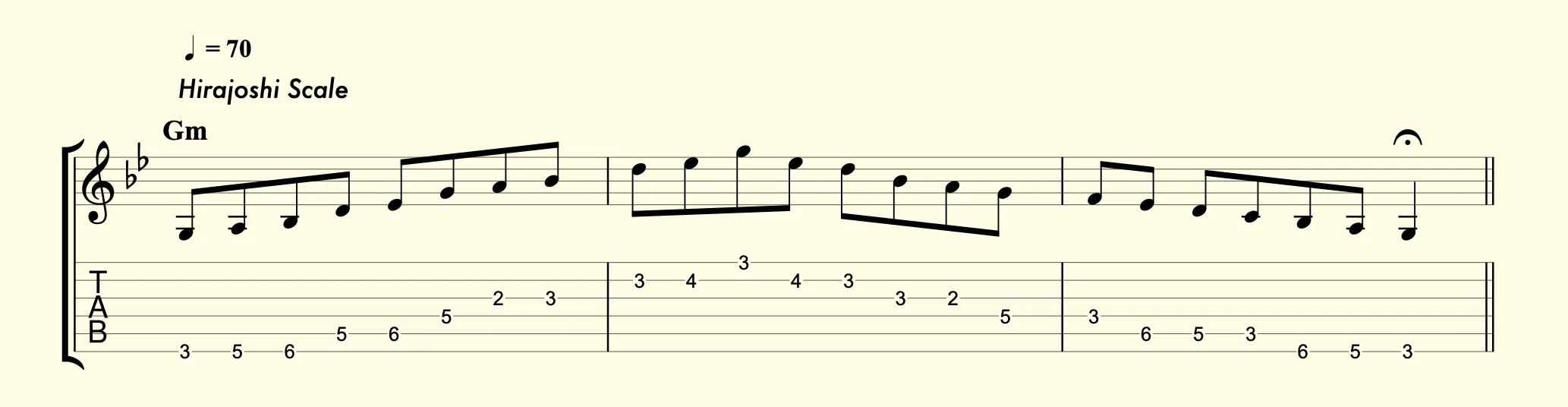
The easiest way to understand it is by comparing it to scales you already know. Like the minor pentatonic, we take the natural minor scale and remove two notes. The minor pentatonic drops the 2nd and b6; Hirajoshi drops the 4th and b7 instead.
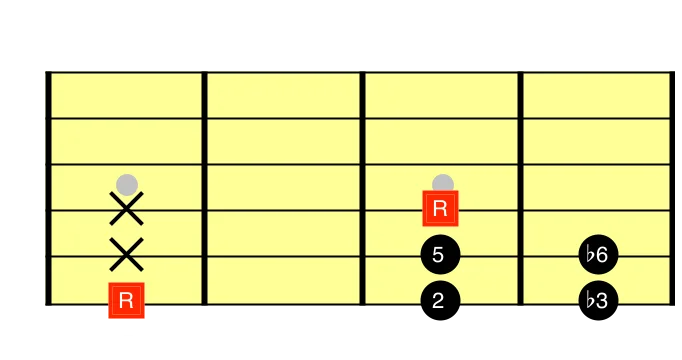
Play those three back to back and you’ll immediately hear what changes. The minor pentatonic sounds familiar and bluesy; Hirajoshi sounds wider, more open, and distinctly more exotic.
Why Does It Sound Like That?
Two things are responsible for the scale’s character, and it’s worth understanding both of them.
First, the major 3rd jumps. Between the b3 and the 5 (Bb to D in Gm) there’s a major 3rd – a much wider leap than you’d normally expect inside a five-note scale. The same jump appears from the b6 back up to the root as the pattern cycles around (Eb to G). These two wide leaps are doing most of the heavy lifting in creating that exotic quality.
Second, the half-steps. Sitting right between those wide leaps are two semitone intervals: between the 2nd and b3 (A to Bb), and between the 5 and b6 (D to Eb). That combination of wide jumps and tight half-steps is what gives Hirajoshi its distinctive tension.
A Symmetrical Shape to Explore
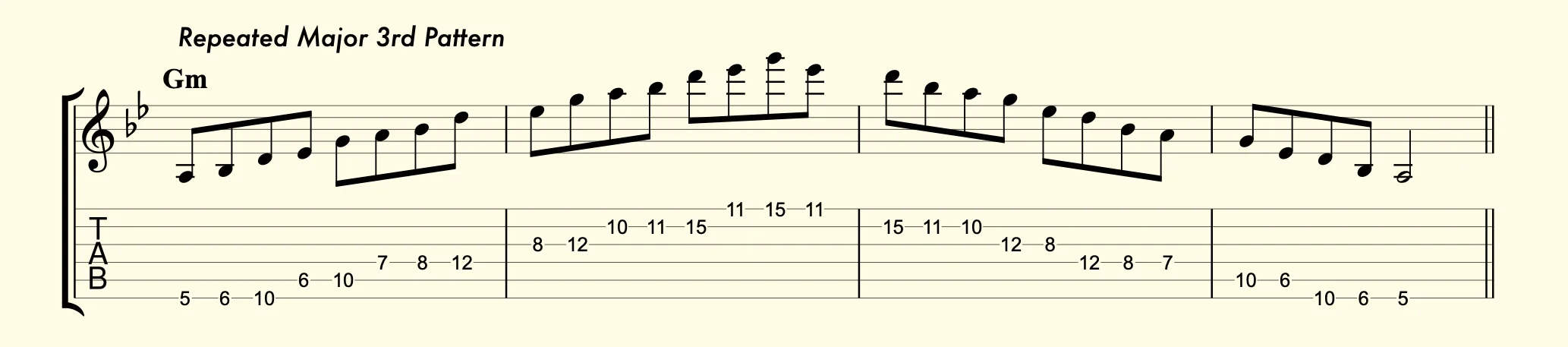
I’m not a huge fan of purely shape-based playing, but this scale has a nice internal symmetry worth knowing about. Here’s a three-octave pattern starting from the A string (5th fret):
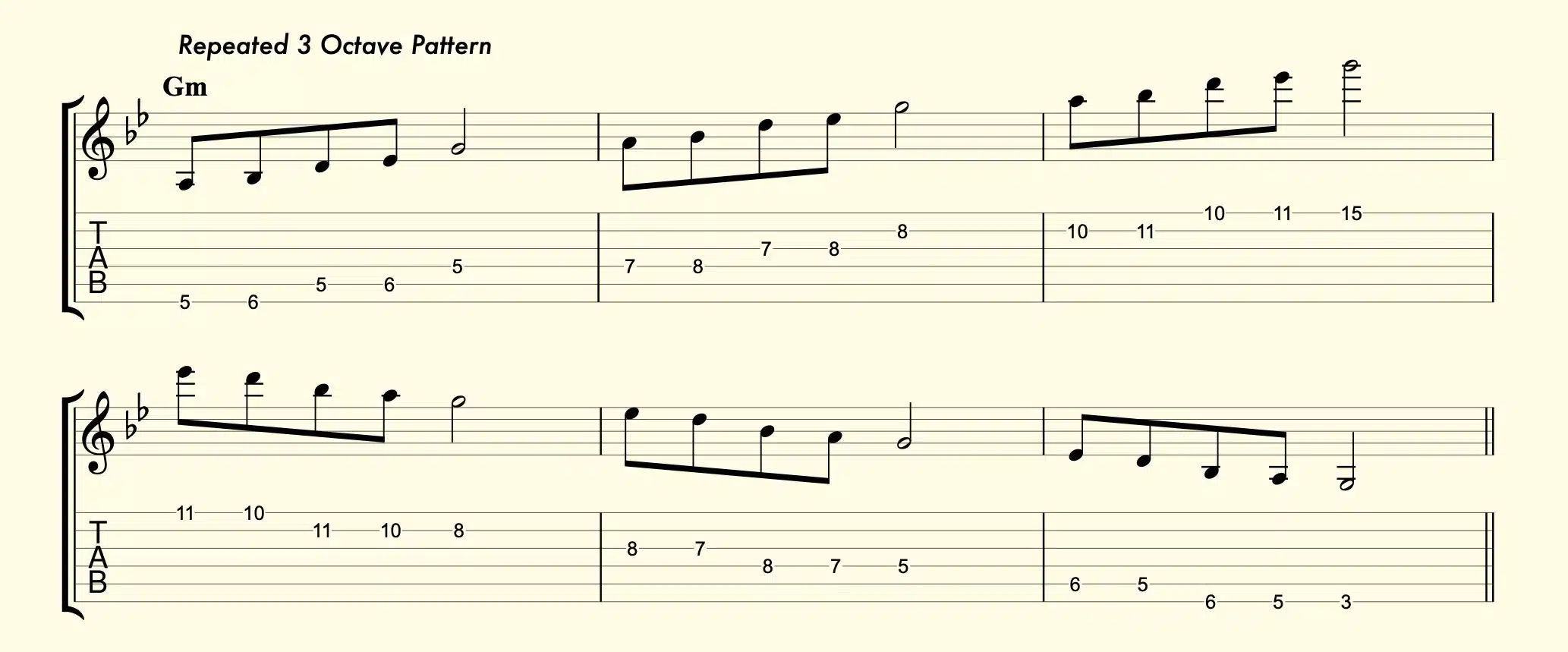
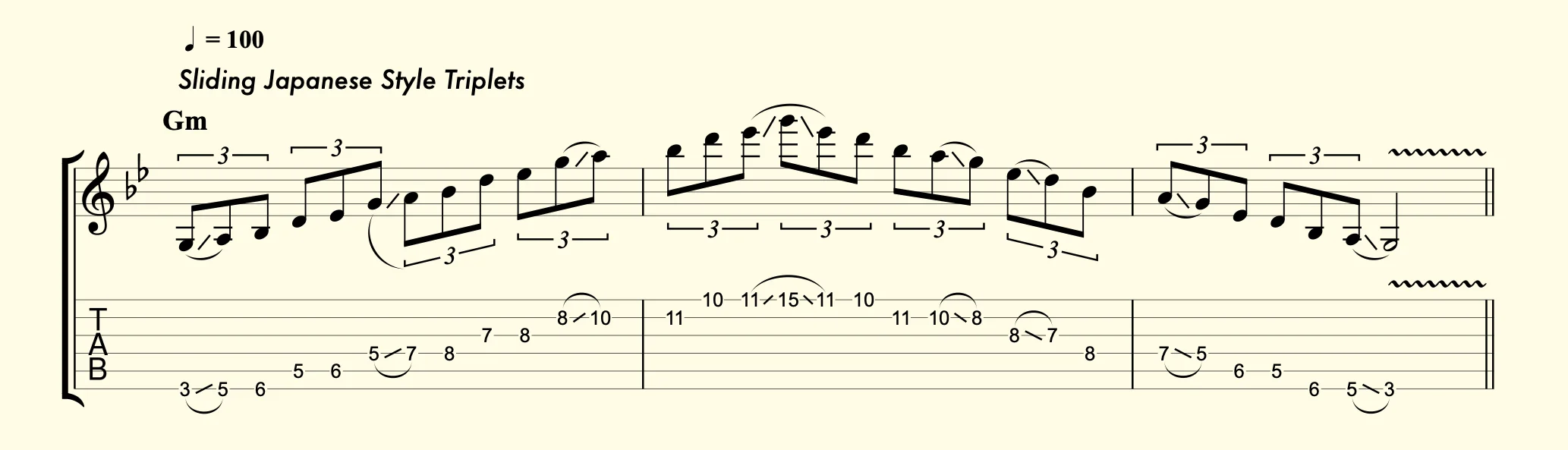
Notice how the same fingering pattern repeats across each pair of strings. This symmetry lends itself well to slides, which adds an even more Japanese, koto-like flavour to the phrasing:
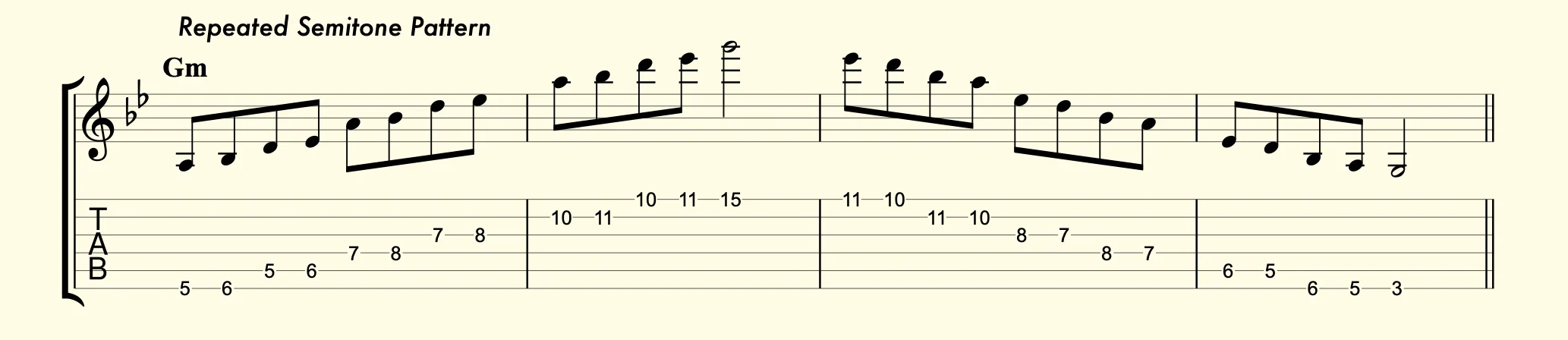
You can also visualise the scale two different ways — emphasising either the repeated semitone shapes:
Or the repeated major 3rd shapes across the octaves:
Where You’ve Heard It
Marty Friedman and Jason Becker were both deeply influenced by Japanese music and built some of their most distinctive playing around this scale. Marty’s use of it runs throughout his Megadeth years – the solo in “Tornado of Souls” is a great starting point – and Jason Becker leans into it heavily in “Altitudes” from the Speed Metal Symphony album.
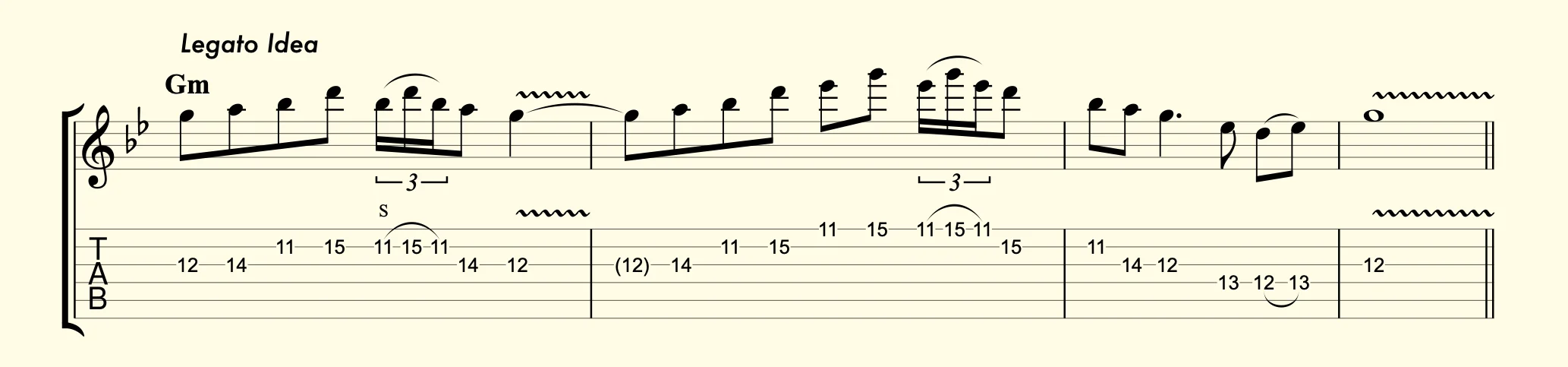
The next few examples work equally well with distortion and glassy cleans, so pick your sound and try them out.
One of my favourite positions to work from is 11th position on the G minor shape:
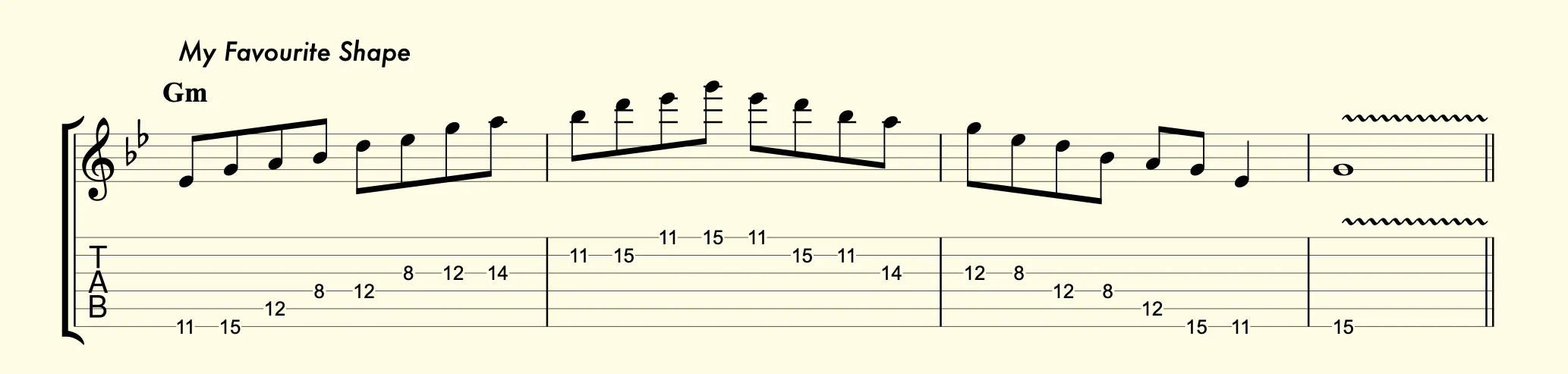
Up here you’ve got easy access to both minor 2nd intervals and both major 3rds, which makes them simple to target and work really well with legato phrasing.
Getting Away from Predictable Sequences
The two-notes-per-string shape of most pentatonic scales tends to push guitarists toward predictable triplet sequences. Here’s what I mean:
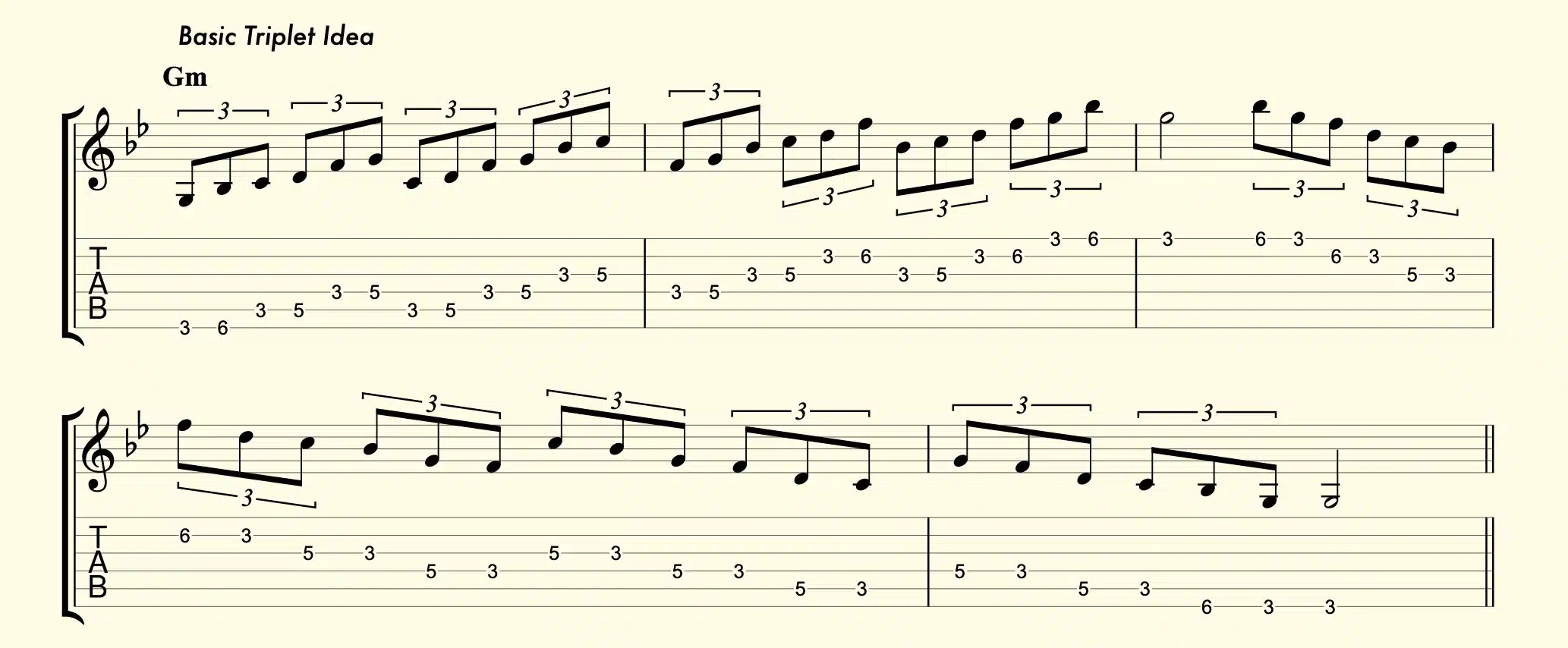
The same approach applied directly to Hirajoshi sounds decent:
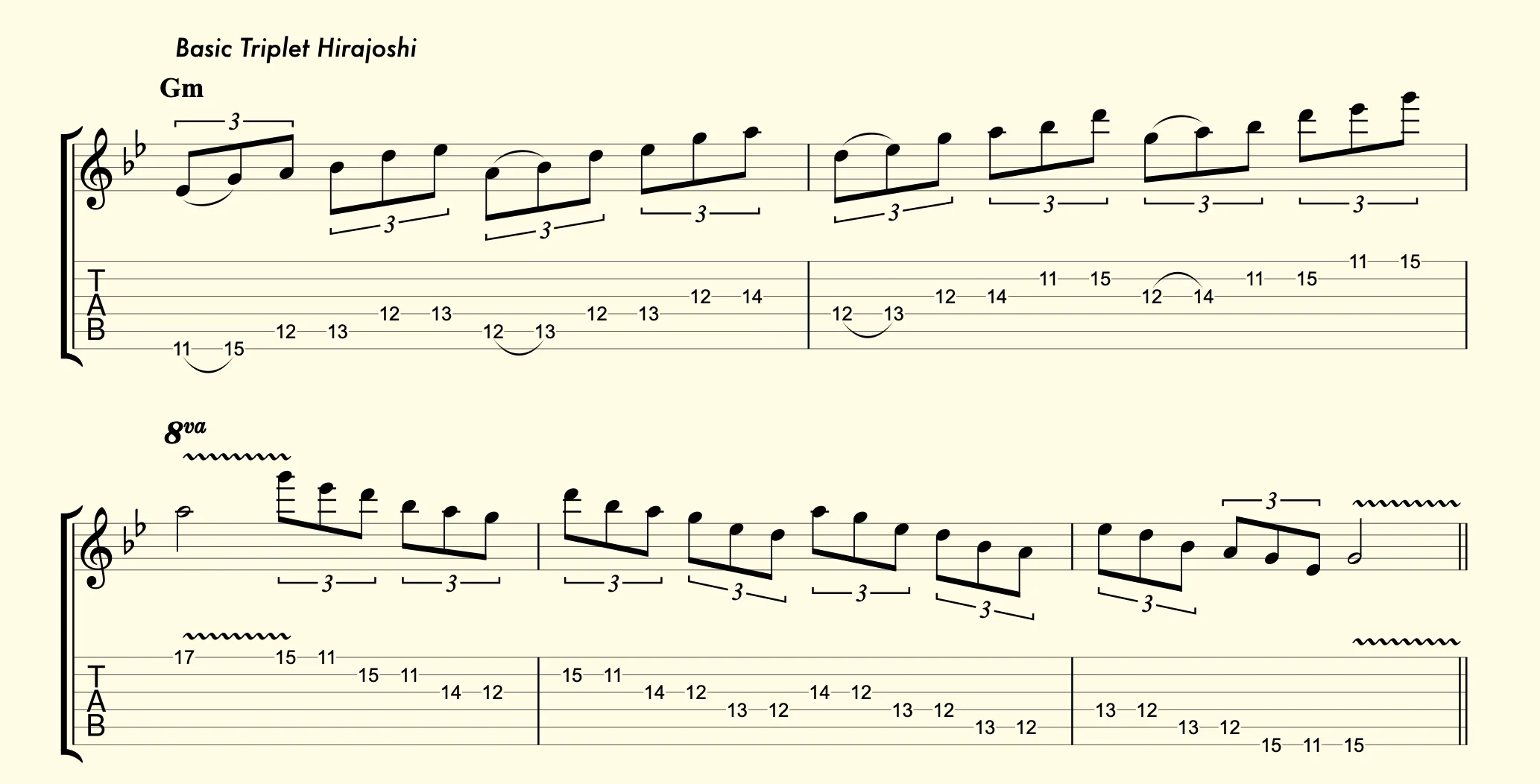
But we can make it far more interesting by varying the note groupings:
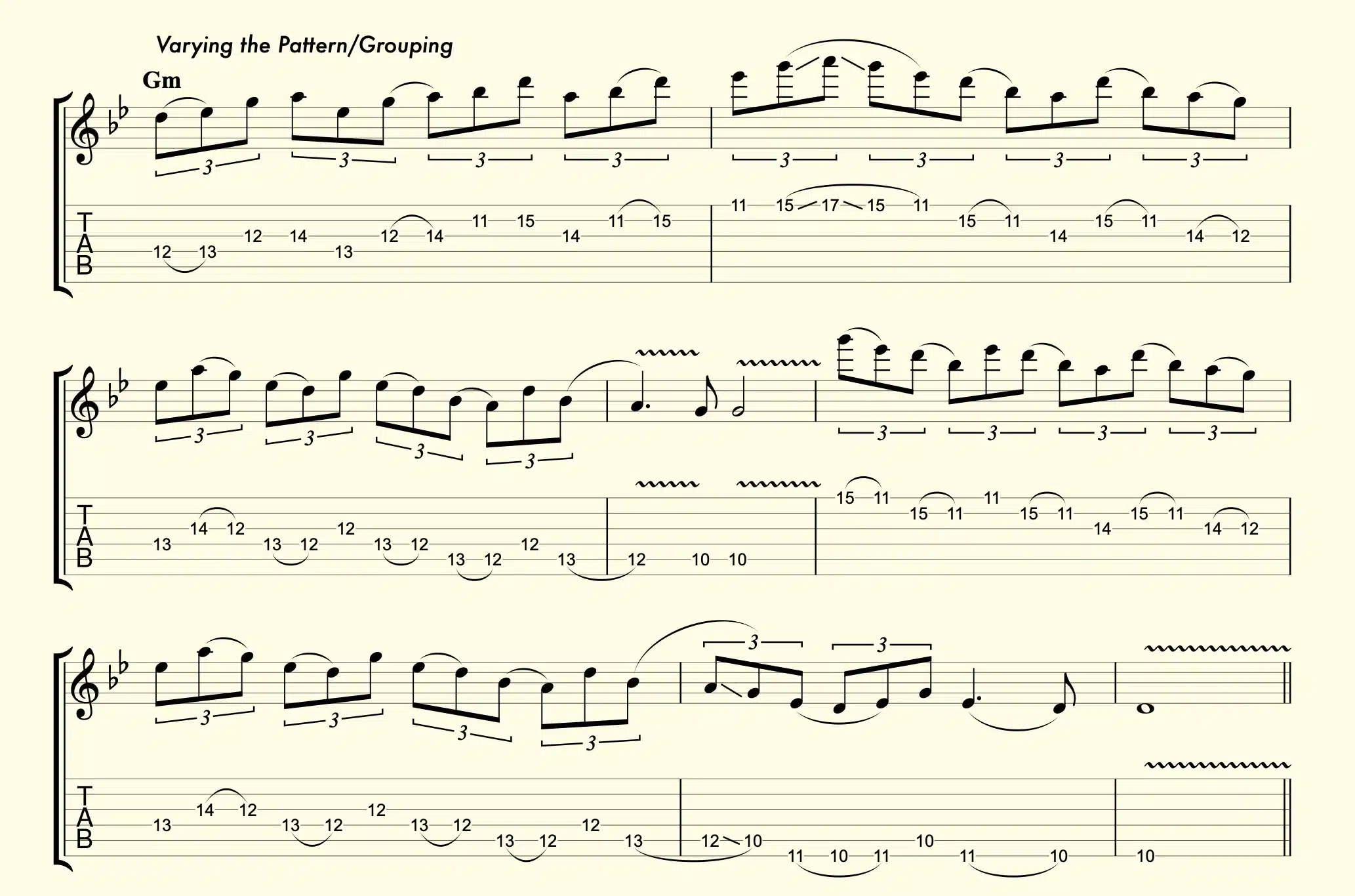
The principle is simple: avoid locking into a single number of notes that keeps repeating. Mixing groups of 4 and 5 (or 3 and 4) immediately makes the phrasing feel less mechanical and more musical.
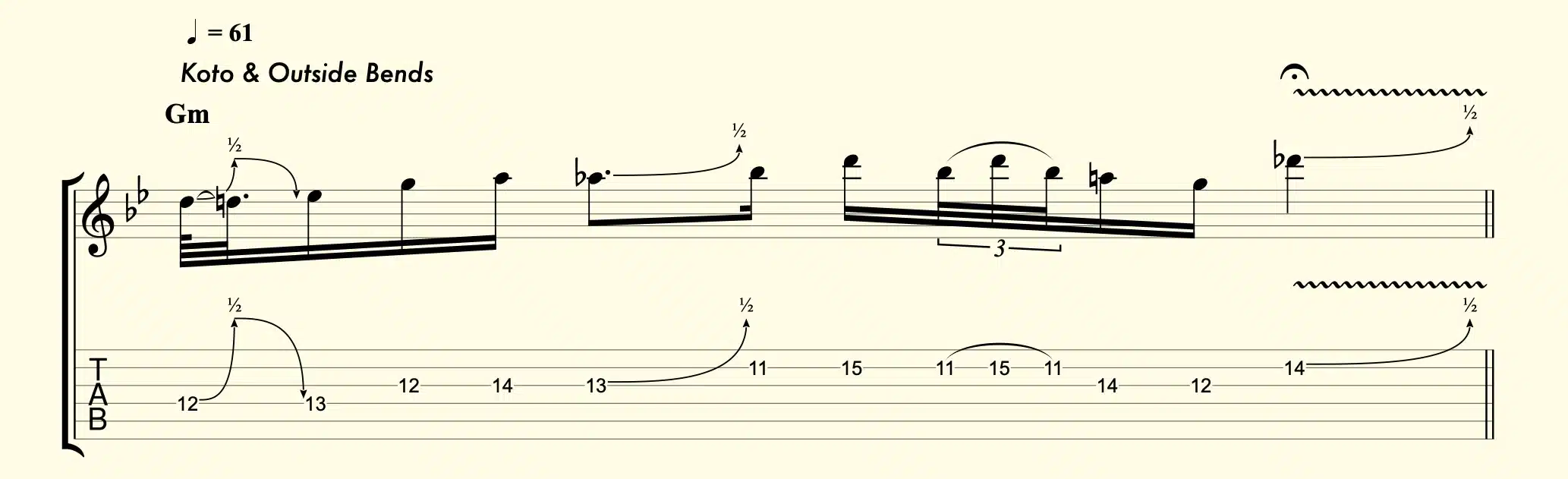
Koto Bends and Outside Approach Notes
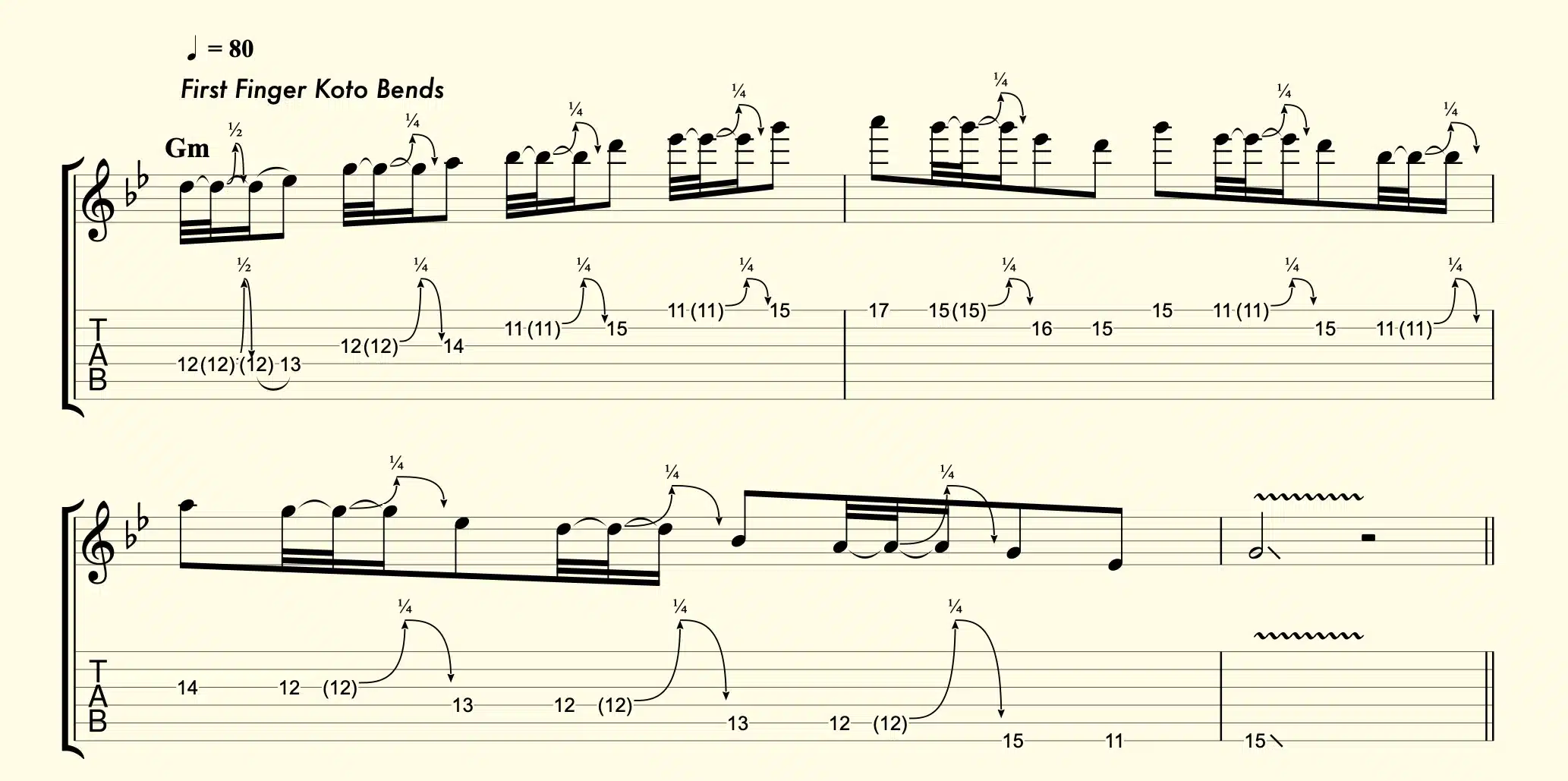
This is the detail that makes Marty Friedman’s Hirajoshi playing sound like his. He uses two specific techniques worth adding to your toolkit:
Koto bends — a very quick microtonal bend-up and immediate release, almost like a subtle whammy bar flutter. They work especially well on the half-step notes under the first finger:
But you can apply them elsewhere in the scale too:
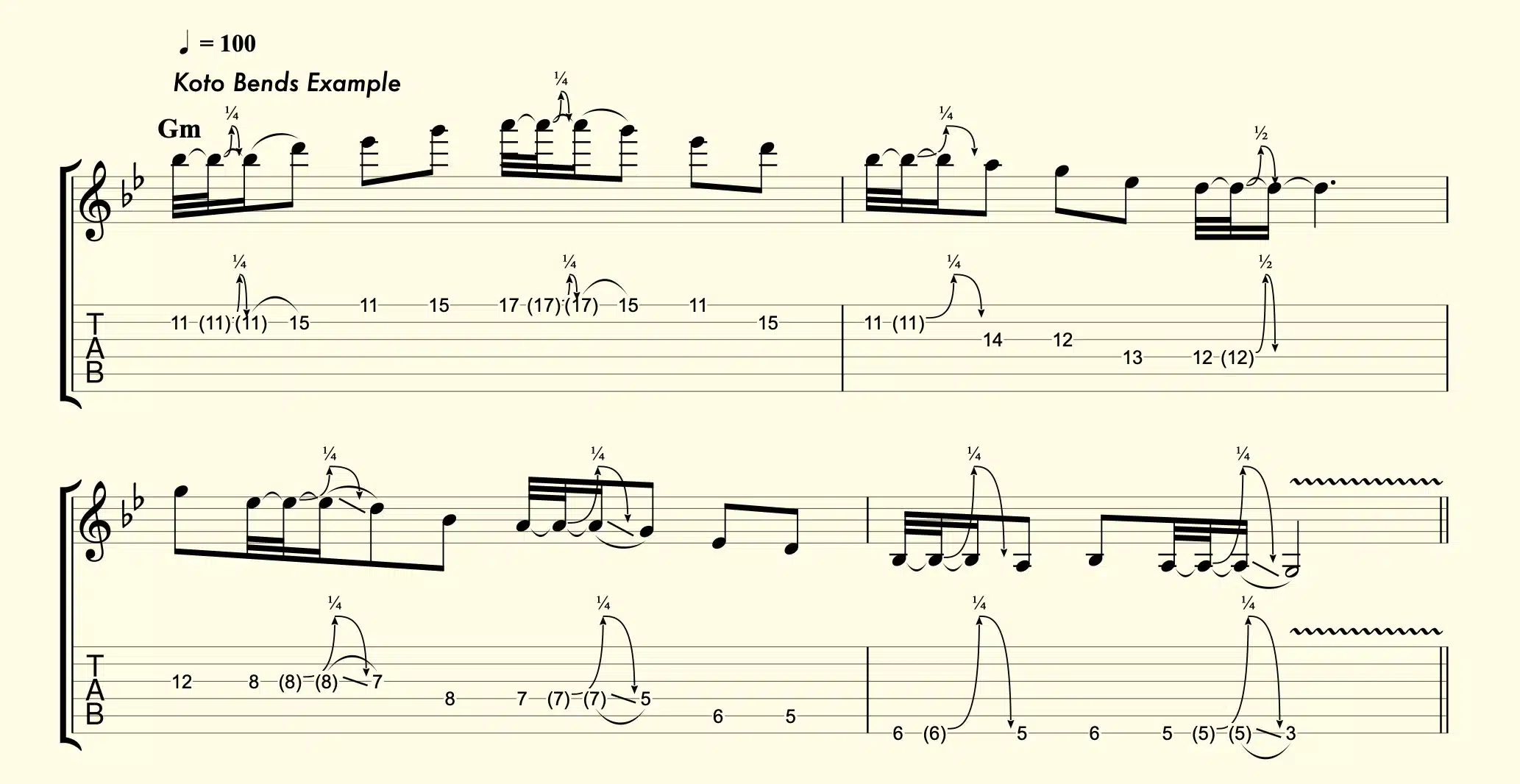
Semitone-below approach bends — bending chromatically into a scale tone from a half-step below. Within this scale, bending into the 2nd/9th and the 5th are particularly effective:
How I Think About Harmonising This Scale
Most guitarists learn a scale as a series of notes and leave it there. The more interesting question is: what chords are hiding inside it? That’s where the scale stops being a party trick and starts being genuinely useful.
Start by harmonising a standard G minor scale and you get predictable triads — Gm, Am(b5), Bb, Cm, Dm, Eb, F:

Now do the same with Hirajoshi. Because of those large interval jumps, you don’t get clean triads – you get much more interesting, non-triadic chord structures:
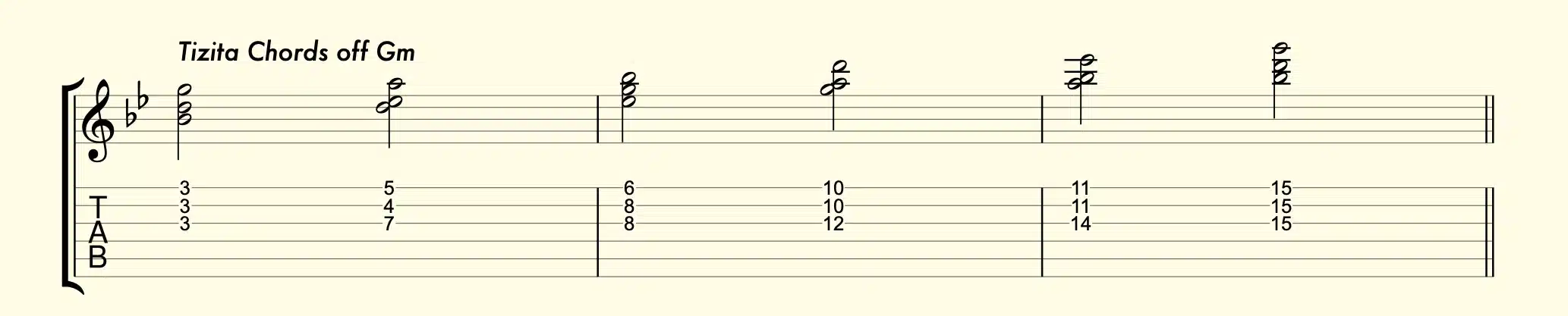
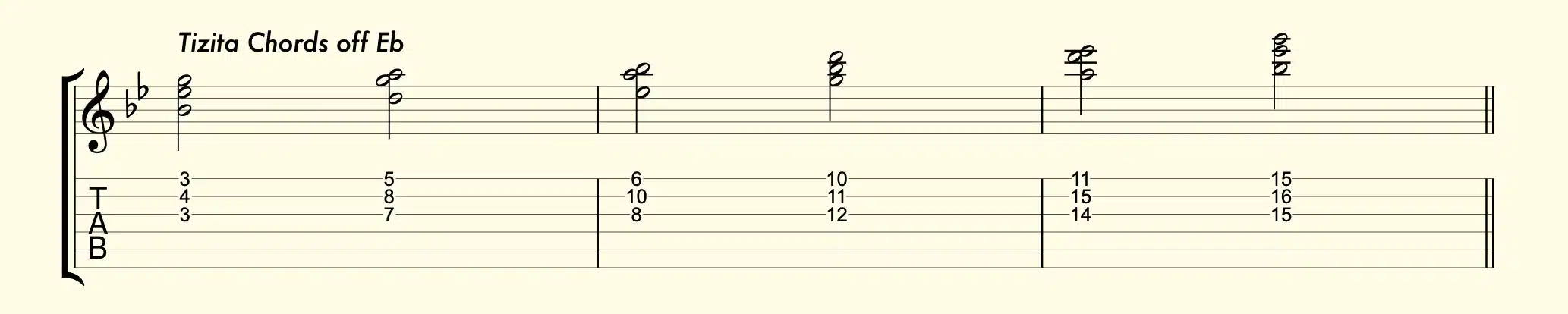
Eb is a natural triad found inside of the G Hirajoshi, so we can also use this as a starting point and harmonise in the same way. Check out the beautiful chords we end up with here:
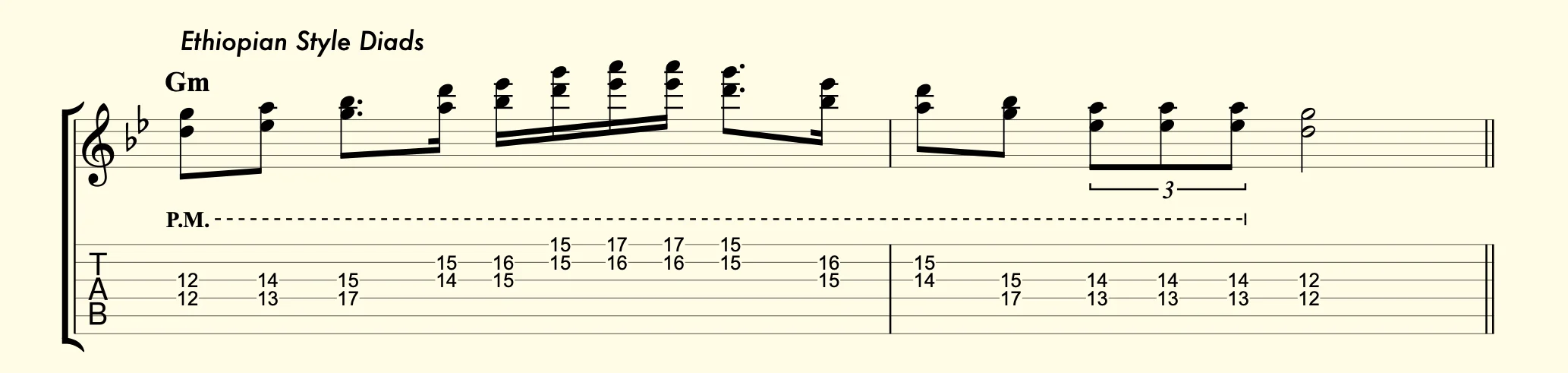
Even just working with diads (two-note intervals – or dyads – maybe it’s just me but I’ve always spelt it “diads”) across the scale produces some wonderful sounds.
Starting from 3rd position, the intervals go: 4th, b5, minor 3rd, 4th, 4th, 4th. Those three consecutive 4ths have a particularly Ethiopian quality to my ear:
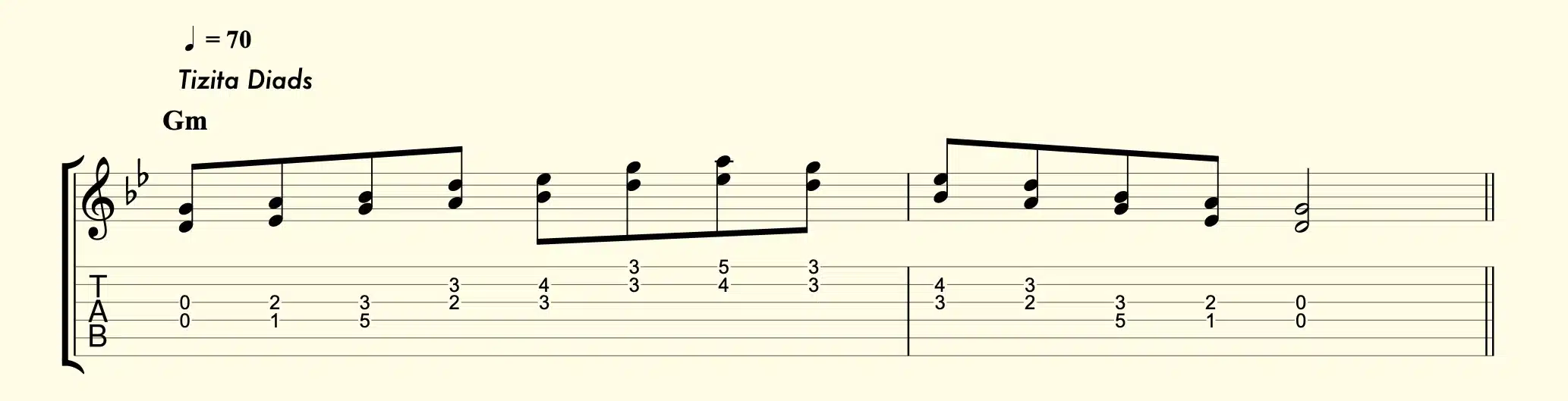
Moving up the octave with a bit of palm-muting is very reminiscent of Mulatu Astatke, who was basically the Godfather of Ethio-Jazz:
The broader point: find the interval that defines the scale’s personality — in this case, those major 3rd jumps and half-step clusters – and build your most interesting chord ideas around those, rather than defaulting to stacking conventional triads.
Putting It All Together
In my YouTube video I play a full improvised solo over a North African / Ethio-jazz-flavoured backing track in Gm, pulling together the ideas above — the symmetrical shapes, the mixed groupings, the koto bends, and some of the dyad ideas from the harmonisation section.
What I find interesting when I play this solo back is how little it sounds like a “shred” scale being applied to a jazz context, and how much it sounds like it actually belongs there. That’s the Tizita minor side of the scale coming through – when you phrase it with space and let those wide intervals breathe, it pulls naturally toward that Ethiopian vocal quality.
Get the TAB and Backing Tracks
All the tab examples from this post plus full solos – plus both the African groove and rock backing tracks – are available via the link below.
If you found this useful, the YouTube video above covers all of this with live demonstrations, which is worth watching alongside the tab. And if you’d like more posts in this vein – scales, harmonisation breakdowns, that kind of thing – subscribing to the channel is the best way to catch them!