Start playing the solos you hear in your head.
Doug M
Matthias S
Joe M
Leon B
Thomas O
Stewart K
Eric F
Carlos M
Frank A
Bernhard H
Doug M
Matthias S
Joe M
Leon B
Thomas O
You know the feeling.
It’s your moment to solo. All eyes are on you – and out comes… the same lick. The same blues line you’ve played a hundred times before. Reliable. Safe. Maybe a little bit disappointing?
You’ve heard what you want to sound like. Robben Ford playing a line so saucy and outside that it makes it makes your head turn (and maybe do the “stank” face). Scofield twisting a phrase just far enough outside the changes that it shouldn’t work, except it does. Oz Noy, Larry Carlton, Scott Henderson, Jimmy Herring – that “wonky,” slightly off-centre sound that makes a solo feel like a statement instead of a scale exercise.
You’ve probably even tried to get there. Maybe you dabbled with side-stepping, or looked into the diminished scale, or messed around with melodic minor. And what happened?
It either sounded like something you pasted in, or it sounded wrong. Not “outside and interesting” wrong – just wrong wrong.
So you backed off, and bailed back to the pentatonic box (and don’t get me wrong – I love the pentatonic scale!!!)
And I’m here to tell you, that’s not a talent problem. It’s a systems problem – and it’s exactly what this course fixes.
You're stuck inside the pentatonic bubble
You’re confident in the first box. Comfortable enough in the other four. Maybe you know Dorian and a few “outside” scales. You can find the intervals in a chord if you take a second to think about it. In other words – you’re not a beginner. You’re stuck.

And that’s a more frustrating place to be than being a beginner. You have the technique. You have some of the theory pieces. But something isn’t connecting, and it shows up in a few familiar ways:
- Your solo defaults to autopilot. The spotlight's on you, and instead of playing what you've practised, you play what your hands already know – the same blues lines, over and over.
- You're overly focused on patterns, not sound, groove or harmony.
- You've tried "outside" and landed on "wrong". You hit the note. It didn't resolve. It just sat there sounding like an error – because nothing about how you played it told the listener it was on purpose.
- You know some theory but you can't use it in real time. You could probably explain a diminished chord on a whiteboard. But trying to do it at tempo, in the middle of a solo, without stopping to think – that's a different skill entirely, and nobody taught you how to do that.
Here's the part most guitarists never figure out on their own
Playing “wrong” notes on purpose is not a note-choice problem. It’s a confidence problem.
A note played with hesitation always sounds like a mistake – even if it’s theoretically correct.
The exact same note, played with commitment and resolved deliberately back into the changes, sounds like intention. Like a choice. Like the “head-turning” moment you’ve been chasing.
That’s the gap. Not more scales. Not more theory. A system that gets the sound into your ears, the shape under your fingers, and the confidence to commit to it when soloing – every time.
Introducing:
Mastering the Diminished
Beautifully Twisted Sounds for Blues, Fusion & Beyond
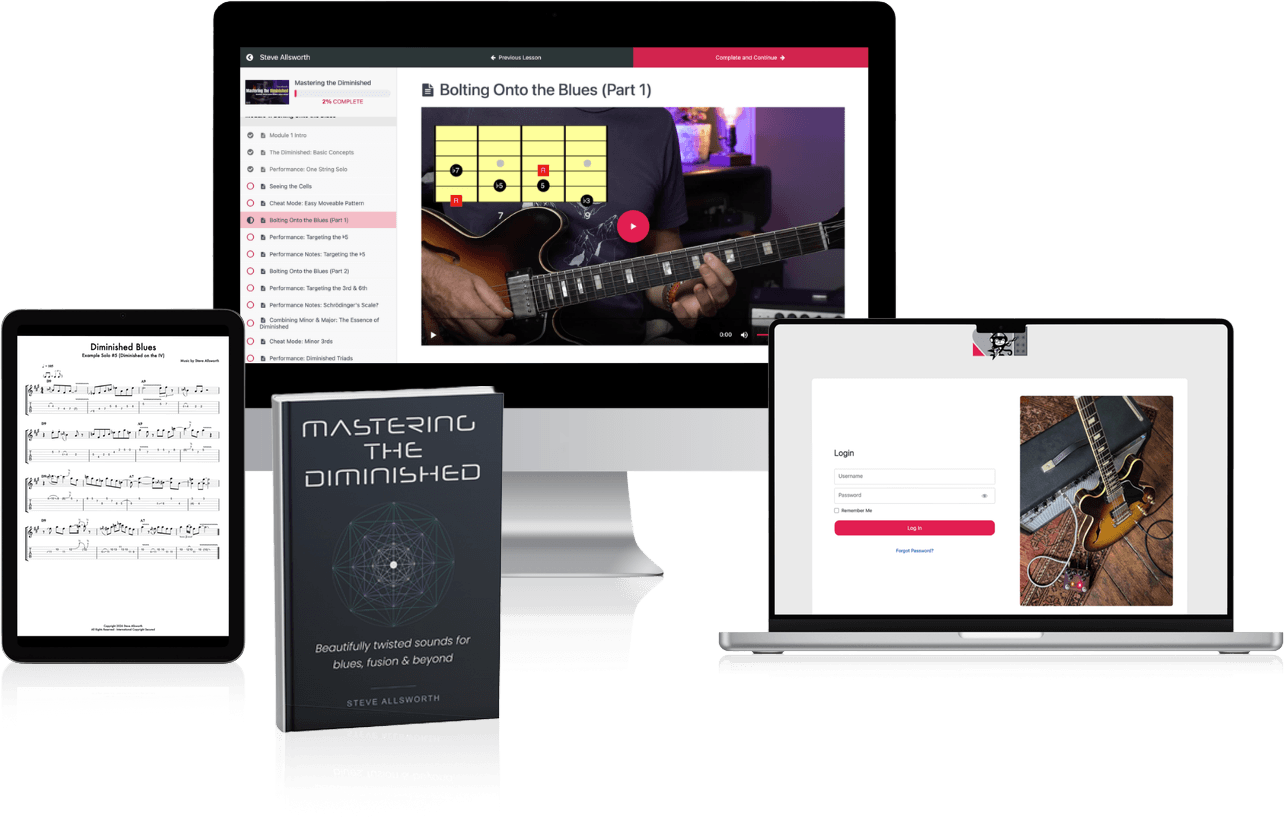
A strategic roadmap for intermediate guitarists to level-up their outside playing
This isn’t yet another lick pack that you’ll never use in the real world. It’s not a theory dump. It’s a comprehensive system for using the diminished scale – and the concept of tension and release underneath it – to permanently expand what you can do in a solo.
You’ll move from running scales to what the best players actually do: singing unique lines through your beloved instrument.
Better phrasing. Chord-tone targeting. Deliberate practice built specifically to isolate and strengthen the skills that don’t show up when you’re just noodling.
What you'll walk away with:
- More fretboard freedom – the diminished scale's symmetry, understood "under the hood" and well enough that you're not relying on memorised boxes to find it
- The confidence to actually play outside – live, at tempo, without hesitating or bailing out halfway through the phrase
- Real harmonic understanding – not just "outside = diminished," but why it works, where it works, and how to get back inside so it resolves instead of just stopping
- A working knowledge of chords and intervals you can apply on the fly, not just explain after the fact
- Better phrasing – rhythm and contour, so your outside lines sound like sentences, not scale runs
- Better theory – applicable, deeper knowledge, because it's been broken into digestible pieces
No more disconnected theory concepts or aimless practice.
With Mastering the Diminished, alongside a commitment to practice, within weeks you’ll be able to start playing beautiful, twisted solos using the sounds of the diminished scale and its harmony.
This isn’t a course you binge in a weekend and forget by Friday. Mastering the Diminished is built as a 90-day pathway – three modules released progressively, giving you time to actually get the techniques under your fingers and the concepts in your brain before the next stage builds on it.
Rushing through concepts without practicing them in context is how most players end up right back where they started.
This course is designed so that doesn’t happen to you.
By the end of the 90-day course you’ll have the tools to tackle static grooves, blues and jazz progressions, play over altered V chords, II-V-Is – all with more freedom than you ever thought possible.
You’ll also go in-depth into the harmony so you can improvise with a whole new set of colourful chords and even start writing your own chord progressions.
How It Works
The key to unlocking your soloing potential
You’ll train your ear to actually recognise the diminished sound and its unique inside/outside makeup. This is the foundation of how you’ll learn to harness tension and release, so you’re reaching for it on purpose, not stumbling into it by accident.
You’ll learn exactly where this scale fits – over dominant chords, over diminished chords, in turnarounds – and get the shapes and fingerings under your fingers so they’re second nature, not something you’re hunting for mid-solo.
Knowing the notes means nothing if it doesn’t groove. This is where you’ll learn to phrase like a boss – rhythm, contour, timing – playing over real backing tracks with real drums, bass and guitar so your lines actually sit in a groove rather than sounding like an exercise.

This is the one most courses and surface-level YouTube videos skip. Knowing scales, arpeggios and chords isn’t the same as being able to commit to them live, at tempo, and resolve them so they sound deliberate and musical. That’s the real transformation this course offers – going from “I think I know a concept” to “I’m confident in exactly how and when to use it”.
7 Steps to Mastering the Diminished
Your 90 Day Pathway
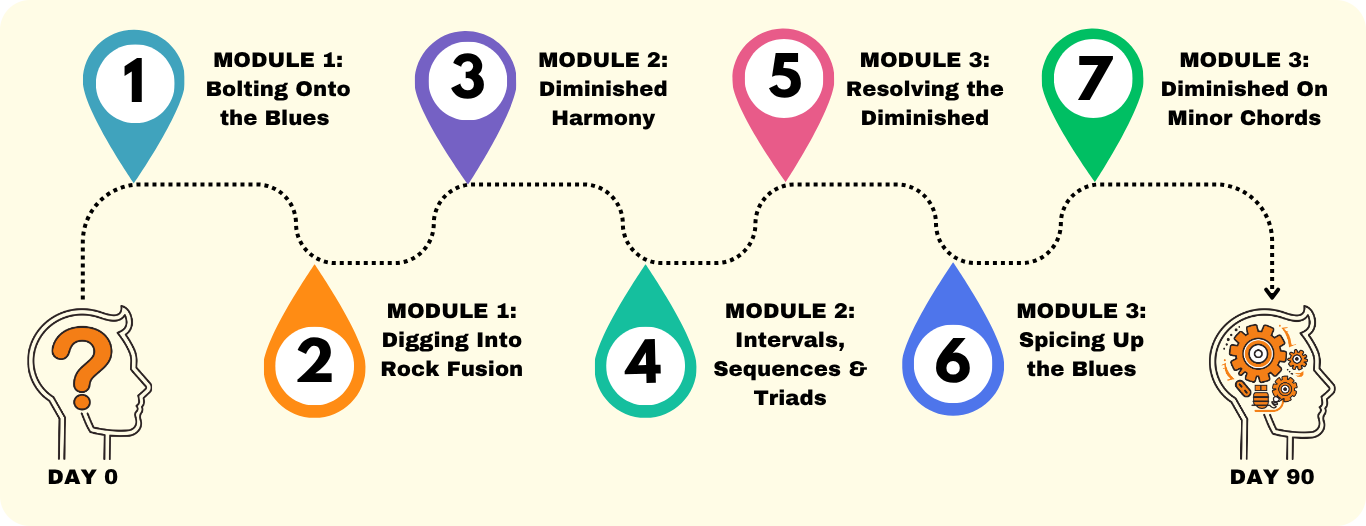
A 90-day journey, not a data dump.
Modules unlock every 30 days so you build real technique, one stage at a time.
course breakdown
A taste of what's inside Mastering the Diminished
Here’s an overview of the full curriculum for Mastering the Diminished. You’ll get instant access to Module 1 when you join
Module 1: Bolting Onto the Blues (17 Lessons)
- Soloing on One String – bust out of learned boxed patterns
- Fretboard fundamentals – applying the "scale island" shape to the underlying chord
- Targeting specific outside tensions within the diminished scale
- Scaffolding the diminished around the blues
- Harnessing the the Major 3rd/minor 3rd "split personality" of diminished
- Dom 7/Dom 7(b9) connection
- 5 example solos – each solidifying concepts
- Style references: Robben Ford, John Scofield, Larry Carlton
Module 1: Digging Into Rock Fusion (8 Lessons)
- Learning how to play laterally across the whole neck
- Basic legato approaches and "launchpad" ideas
- Breaking up the neck – the "equator" concept
- Connecting up the scale - 3NPS and 4NPS ideas
- Rhythmic concepts – odd groupings
- Rock Fusion Étude – bringing together all lessons from Module 1
- Style references: John Petrucci, Frank Gambale, Guthrie Govan
Module 2: Diminished Harmony (13 Lessons)
- Harmony review – thinking about composing/improvising with chords
- The trick for knowing when to use H/W or W/H diminished
- Dominant connections – going even deeper
- Exploring chords from the diminished
- Chords as a tension device
- Diminished colours – building new chords
- Diminished Fusion Étude – bringing it all together
- Style references: Frank Gambale, Jimmy Herring
Module 2: Intervals, Sequences & Triads (39 Lessons)
- Intervals - every interval of the diminished explored with real world playing examples
- How to really improvise with rhythm – Subdivisions and Rhythmic Displacement
- How to build vocabulary from lines
- String skipping and "wonky" Scofield sounds
- Using sequences to create new sounds
- Harnessing the power of 4ths – less predictable outside sounds
- Triads & Triad Pairs – the "secret sauce" that the pros use to break away from scales
- 24 Example Lines and 1 Full solo
- Style references: Frank Gambale, Oz Noy, Scofield, Scott Henderson, John Coltrane, Michael Brecker
Module 3: Resolving the Diminished (13 Lessons)
- Resolving from V to I – Harnessing the true power of the diminished
- Using voice-leading to resolve in the right place – every time
- Crafting lines with Diminished 7th arpeggios
- Artful arpeggios – using the diminished Major 7th
- Pivot arpeggios - the secret to more melodic lines
- Resolving to a minor chord
- 6 Solos and a Minor Étude - making music with the concepts
- Style references: George Benson, Grant Green, Wes Montgomery
Module 3: Spicing Up the Blues (14 Lessons)
- Secondary Dominants – Using diminished on the I chord
- Adapting player's lines – finding your own voice
- Using diminished on the V
- The Gospel Lift – using the diminished on the IV
- Jazz Blues - using the diminished on the VI
- Resolving to a minor chord
- Guide Tones - the secret to seeing the changes
- 10 full solos - steering you through the blues with real world ideas
- Style references: Josh Smith, Oz Noy, Robben Ford, George Benson
Module 3: Diminished on Minor Chords (10 Lessons)
- How to go more outside/fusion – using diminished on minor chords
- The phantom V chord – using implied harmony
- Mike Stern ideas - scaffolding around the minor scale
- Bebop/Fusion-style Chromatics – treading between the cracks
- Scott Henderson ideas – wonky string skipping and triads
- 10 "in the style of" soloing ideas in total – all over a fusion backing track
- Style references: Mike Stern, Scott Henderson
These aren’t a bunch of dry lessons – every concept is taught through the lens of beautiful back tracks that you’ll love playing over time and again.
Shuffle Blues, Rock Fusion, Jazz Fusion, Latin Bossa, Slow 12/8 Blues, Funk and more – all with lashings of groove and real instruments – designed to inspire you to improvise with pocket.
Is Mastering the Diminished right for you?
- Yes if:
- You’re confident with blues and pentatonic playing
- You’ve got at least the first box down cold (and you’re fairly comfortable in the other four)
- You can find the intervals in a chord (even if it takes you a second)
- You know the notes on the neck without much struggle
- You listen to guys like Robben, Scofield, Henderson, Jimmy Herring or Oz Noy and think, “I want some of that outside sauce in my playing!“
- You’ve tried to play “outside” but it sounded wrong
- You’re ready to stop saying “this is the year I’ll learn how to improvise more freely”
- Maybe not:
- You’re a relative beginner – this course assumes a foundational knowledge of blues soloing, chords and intervals and builds on top of that
- You’re looking for a shortcut or “hack”. This course is a comprehensive system – it’ll take real, deliberate practice. If you’re after a 15-minute fix, this isn’t it. If you want a genuine lasting shift in how you solo, it is
- You want a pack of licks to memorise and copy – licks get you one sound in one context. This course teaches the system underneath them, so you end up generating your own lines
- You’re not willing to put in 2 hours a week (spread out)
- Outside sounds don’t give you the “stank face”
- Yes if:
- You’re confident with blues and pentatonic playing
- You’ve got at least the first pentatonic box down cold (and you’re fairly comfortable in the other four)
- You can find the intervals in a chord (even if it takes you a second)
- You know the notes on the neck without much struggle
- You listen to guys like Robben, Scofield, Henderson, Jimmy Herring or Oz Noy and think, “I want some of that outside sauce in my playing!“
- You’ve tried to play “outside” but it sounded wrong
- You’re ready to stop saying “this is the year I’ll learn how to improvise more freely”
- Maybe not:
- You’re a relative beginner – this course assumes a foundational knowledge of blues soloing, chords and intervals and builds on top of that
- You’re looking for a shortcut or “hack”. This course is a comprehensive system – it’ll take real, deliberate practice. If you’re after a 15-minute fix, this isn’t it. If you want a genuine lasting shift in how you solo, it is
- You want a pack of licks to memorise and copy – licks get you one sound in one context. This course teaches the system underneath them, so you end up generating your own lines
- You’re not willing to put in 2 hours a week (spread out)
- Outside sounds don’t give you the “stank face”
Enrollment Now Open – Save $48
 Founding Member Launch Pricing only available for a short time
Founding Member Launch Pricing only available for a short time
Great value for guitarists who are serious about progress
When you join Mastering the Diminished you get nearly 5 hours of video instruction – no fluff, structured as a complete pathway, not a random pile of lessons and licks with no context.
- Private tuition (twice a month, over the 3–6 months this course covers): $500 – $1,000
- A professional music school route covering the same ground: $10,000 – $23,000
- 114 in-depth video lessons, 20 full solos, over 30 example lines and 3 performance études
- Guitar Pro & PDF tabs for every solo and example – meticulously transcribed, so you’re never guessing at a phrase or a fingering
- 5 accompanying PDF books ($60 total value)
- 11 professional backing tracks ($60 total value) – real drums, real bass, real guitar. No AI-generated backing tracks. These are built to feel like a real bandstand in a variety of styles, so the outside sounds you’re building actually get tested against a real rhythm section, not a static loop
- Access to the players’ forum – ask questions, get answers from me and other students, post your own playing for feedback. You’re not learning this in isolation

Risk free 14 day 100% Money back guarantee
Join Mastering the Diminished and level up your outside playing today
Lifetime Access
One Time Payment- 114 Video Lessons
- Guitar Pro 8 & PDF Tabs
- Downloadable Backing Tracks
- Access to the MTD Community
- 7 PDF Module Books
- 14-Day Money Back Guarantee
Payment Plan
3 Monthly Installments- Pay in 3 Monthly Installments
- The same lifetime access
FAQs
Q: Why isn't all the content available immediately?
A new module unlocks every 30 days over your first 90 days with the course. This isn’t a restriction – it’s the format working as intended. Mastery comes from practicing each stage before adding the next layer, not from watching/reading through material quickly. Students who get everything at once often feel overwhelmed and retain less. This pacing is designed to fix that.
Q: Do I already need to know theory?
You need some foundation – basic chord/interval knowledge and comfort with blues scales – but this isn’t a music-theory lecture. We’ll eventually go quite deep, but theory is broken into digestible pieces, taught in the order you actually need it, built for a guitar player’s brain rather than a classroom.
Q: What if I'm just starting out?
This course isn’t built for beginners – it assumes you’re already confident with basic blues soloing, know your chord intervals, and are comfortable with at least the first pentatonic box. If that’s not you yet, get that foundation in place first; this course will make far more sense once you do.
Q: What if I get stuck or have a question?
You’re not learning this in isolation. You’ll have access to the players’ forum, where you can ask questions, get feedback on your own playing, and see what other students are working on.
Q: Do I need to be tech-savvy to use the course material?
Not at all. Everything – video lessons, tabs, backing tracks, PDFs – is designed to be simple to access and use. If you can play along to a YouTube video, you can use this course.
Q: Will I be able to use this live?
That’s the whole point of the course. A lot of “outside” playing falls apart the moment it has to happen in real time, at tempo, in front of people. The work we do here is built specifically to close that gap – not just teach you the notes, but get you comfortable committing to them live.
Q: What if I don't have much time to practice?
Are you serious? (Only kidding). The fact is, you don’t need hours a day to make progress – you need a clear plan, focused sessions and consistency. Our 90-day course is designed so that 2 hours spread out across the week will be more than enough (don’t tell me you can’t find 20 minutes a day!)
If you have less than that, then it might take a little longer – but honestly, I’d rather you take your time to digest everything rather than binge-watching!
Q: What if I don't finish the course within 90 days?
I get it – life gets in the way. So don’t worry! Although we release each module every 30 days, you can still take the course at a slower pace to fit in with your schedule. You’ll have lifetime access to the whole course, so you can come back to any lesson time and again.
© 2026 Steve Allsworth. All rights reserved.